




Action > Nintendo > Marble Madness
Release Date: February 1st, 1989
Publisher: Milton Bradley
Developer: Rare Ltd.
Genre: Action - Puzzle
Posted: March 4th, 2006
Last Updated: January 15th, 2012
ESRB Rating: Also Available On: Also Released As: |
Number of Players: Prequels, Sequels and Expansions: Average Completion Time: |
Similar To: Related To: |
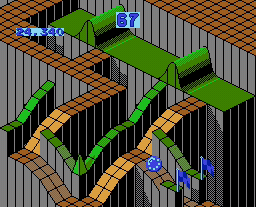 Marble Madness was originally an arcade hit by Atari, and then later ported to the Nintendo. Its fast paced gameplay made it a classic in the minds of some, while some just plain hated it because of the sheer frustration it would cause. In the game you steer a marble ball through a pseudo 3D environment, which is built on an isometric plane. This is why the game is also considered a puzzle game in a sense, but it is more commonly referred to as "action". The arcade version used a trackball to steer the marble, which simulates the actual spherical movement of the marble. On the Nintendo version you have to make due with the directional pad; however, at the beginning of the game you get to choose your control style which makes up for it a bit.
Innovation is what this game strived on to make it a hit. Up until this game, nothing like this was done before. Which I think is why it was successful in the first place, why it was ported to many other systems, and why it still is today being duplicated and emulated in other games. The game itself is fairly short; there is only six levels. But I think it does okay with just six, because it will take you quite some time to actually beat the game anyway. And once you beat it, it's not over. You always want to try to beat your past time and score, or should if you have the competitive edge.
There is something a little strange about Marble Madness. Not the game itself, but the development and publication process in which it was released. Everywhere I look it seems that Rare Ltd. developed this game in 1989. But when you look to the actual cartridge (i've seen/tested 4 different versions), the copyright comes up as Tengen 1984 on the title screen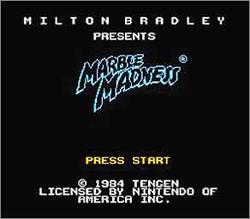 each time. Although in the european version it does have a short credit to Rare, Rare-Coinit Inc. for "program and audio visual" for a couple seconds. I am not really sure on the reasoning, I guess it doesn't really matter anyway. I guess your bound to run into ambiguity when you port the game to every willing, and unwilling console on and off the market at the time.
On December 13th, 2011, Tom Hunt sent me a message concerning the details and explanation on this:
Tengen was the subsidiary that Atari Games, an arcade games developer, used to develop and publish titles for home game consoles, including the NES. Nintendo restricted third party publishers to 5 games per year, so it was not uncommon for a developer to publish games through multiple publishers to work around this without invoking Nintendo's ire. Konami did this via Ultra Games, effectively doubling the number of games they could publish each year.
There was also a bit of a nasty legal dispute between Tengen and Nintendo at that time, which may have, considering Marble Madness's previous success on other platforms (Amiga, C64, arcade, etc), may have caused Tengen/Atari take the route of simply licensing the IP to another developer rather than porting it and publishing it themselves for the NES.

 . 2005-2025 all rights reserved.
Site Last Updated: February 16th, 2010
Search The Gamer's Journal: